


UHCL professors use CustomGPT.ai grant to enhance learning in courses
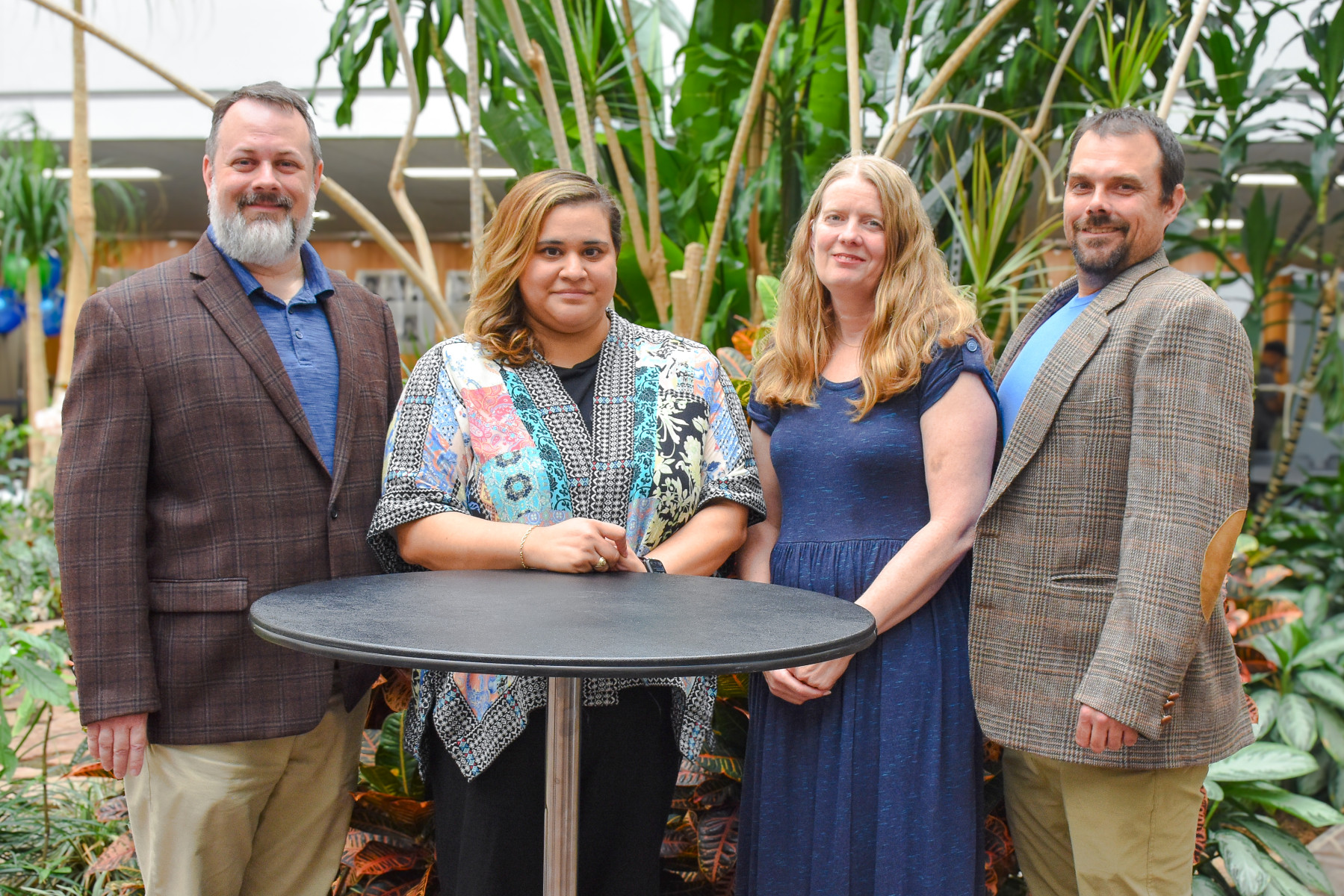
Psychology faculty Dr. Nicholas Kelling, Dr. Christopher Ward, Dr. Angela Kelling, and Dr. Georgina Moreno at the University of Houston-Clear Lake (UHCL) are using a CustomGPT.ai grant to develop open educational resources (OER) for their Brain and Behavior, and various research design and statistics courses. They are also developing chat-enabled interactive tools to enhance how students learn and apply statistics. These resources are designed to transform the learning experience by making it more accessible, personalized, and effective.
“Most faculty members have been interested in how artificial intelligence (AI) will disrupt education since ChatGPT was first released in November 2022,” said Dr. Angela Kelling. “There was an initial panic about how these tools would enable cheating, but I wanted to learn more and truly understand what the AI tools could do and how they might enhance the classroom experience while still allowing students to meet learning goals.”
Dr. Angela Kelling started watching webinars and reading about how AI would transform job functions. She believes in embracing AI tools and shifting professors' focus to adapt to technological disruptions. With rapid advancements in education technology, professors invest significant time in understanding the capabilities and limitations of new tools.
“I believe it is essential not to deny the AI tools' existence but learn about them and determine how they can be helpful to both students and faculty,” she said. “Dr. Ward, Dr. Moreno, and I know that one issue for students is the expense of textbooks, so we wanted to use open-access resources for our Brain and Behavior courses.”
The professors noticed general topics covered early in the semester had decent OER options. However, they could not find the resources they wanted to cover lessons later in the semester. They applied for and received an OER grant from UH-Clear Lake’s Neumann Library to locate, refine, and develop OER resources over the summer so they could use OER resources for the entire fall semester.
When we heard about the CustomGPT.ai grant, we knew it could help us meet our goals of providing students with a free textbook while also helping us learn more about these powerful custom AI tools.

Additionally, the professors are using CustomGPT.ai to create other tools that help students engage with interactive tools, statistics and research methods, and concepts, that will better meet learning goals and develop the critical thinking and problem-solving skills they hope students retain years after taking their courses.
“We are just beginning to use the AI tool as we delayed access to have time to plan and gather resources,” said Dr. Angela Kelling. “We are working together as a team and with the AI to determine how we want to organize the OER,” she continued. “We have a lot of articles that we will upload to the CustomGPT.ai and then ask it to draft text. We will then collaborate to revise the created text and ensure it covers the topics well. We also plan to integrate other resources, like websites and videos, to enhance the text and help students engage with the material.”
The OER text will be piloted in Dr. Angela Kelling’s Brain and Behavior course in the fall of 2024. She and the other professors will continue to refine the text and use the updated version in spring courses. The chatbot for statistics will be fed a lot of examples of calculations. The goal is to create a resource that helps students identify their mistakes and learn how to perform statistical calculations with better accuracy and confidence.
“For the Brain and Behavior course, we hope that by creating free, concise, and engaging texts, students will read them and engage with the material,” said Dr. Angela Kelling. “For the statistic and methods courses, we hope it will be another tool students can use to meet learning goals. We plan to collect data to help us refine the products we create.”
Professors will gather data and feedback from students to assess the usability of the OER materials and identify areas for improvement. The finalized OER text will be added to the Neumann Library’s OER repository for broader access and use.
Dr. Angela Kelling expressed her gratitude to UHCL’s Neumann Library and the Center for Faculty Development for their invaluable support throughout the project.
“Their investment in faculty development is very appreciated,” she said. “We are also thankful to CustomGPT.ai for the grant that allows us to enhance our products and faculty development.”
For more information about UHCL’s Department of Psychology, visit www.uhcl.edu/human-sciences-humanities/departments/psychology/.