



Demographics don’t determine destiny: UHCL scholars named SERA Deans’ Award winners
What if the biggest barriers to student success are not inside classrooms at all, but hidden in city zoning maps, transportation routes, and policies that quietly decide who gets access to opportunity?
At the 2026 annual meeting of the Southwestern Educational Research Association (SERA), two scholars from the University of Houston–Clear Lake proved that transforming education may require rethinking the systems far beyond school walls.
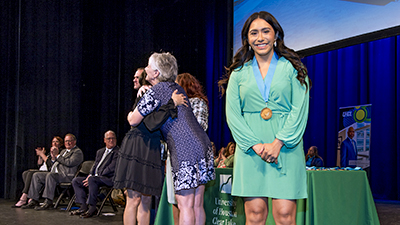
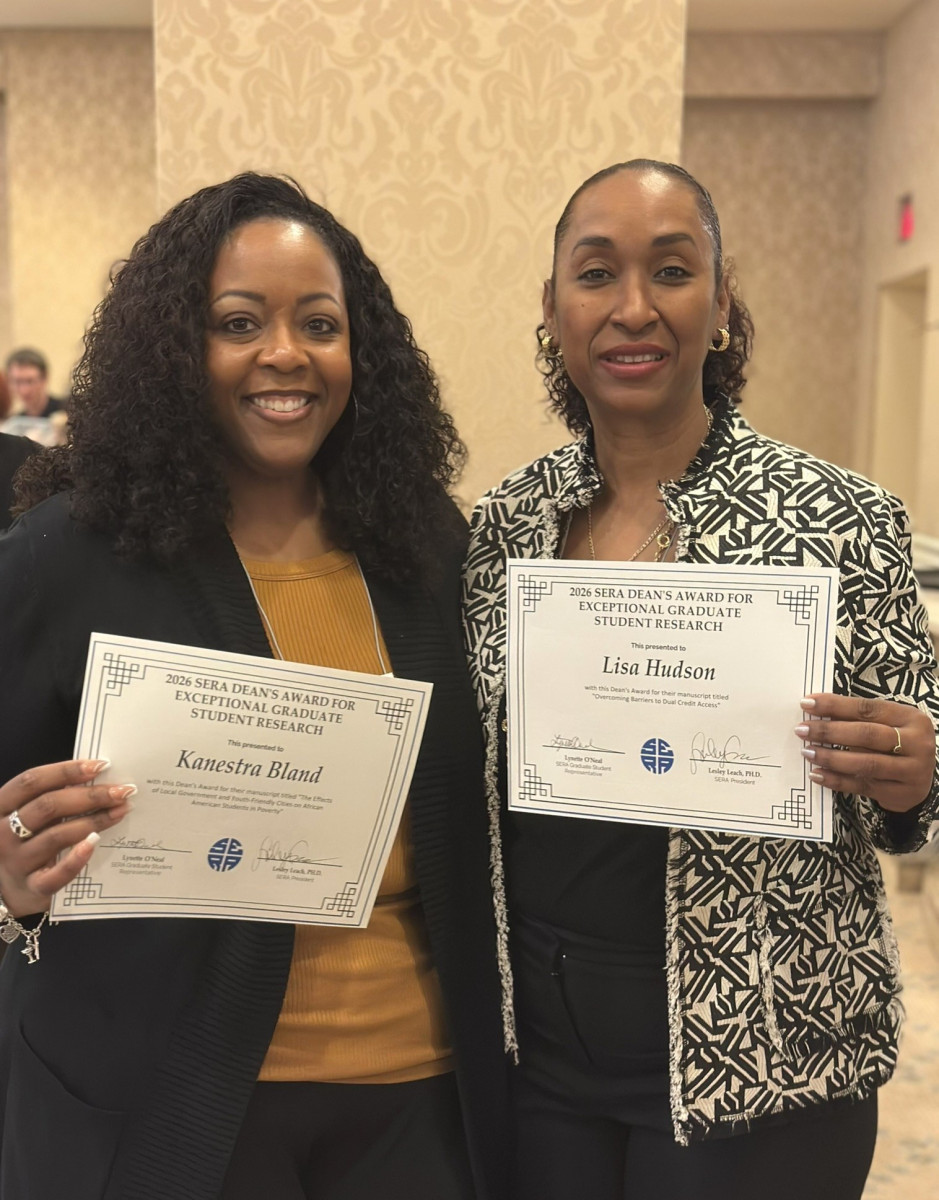
Doctor of Education in Educational Leadership (EDLS) students Kanestra Bland and Lisa Hudson were named recipients of the prestigious Deans’ Awards for Exceptional Graduate Student Research. For Bland and Hudson, the recognition affirms years of study, reflection, and lived experience, but more importantly, it underscores the urgency of the issues they are tackling.
The Effects of Local Government and Youth-Friendly Cities on African American Students in Poverty
Bland’s path to UHCL was personal long before it became professional.
“I was first introduced to the University of Houston-Clear Lake as a young girl because it’s where my father earned his master’s in education,” she said.
Now a middle school principal, Bland returned to pursue her doctorate in the EDLS program with a clear intention: to expand her impact beyond a single school building.
“As a campus principal, I wanted a doctoral experience that would challenge my thinking while remaining grounded in real-world impact,” she said. “UHCL offered both academic rigor and a deep connection to the communities we serve.”
Her research pushes that community connection even further, past district offices and into city government.
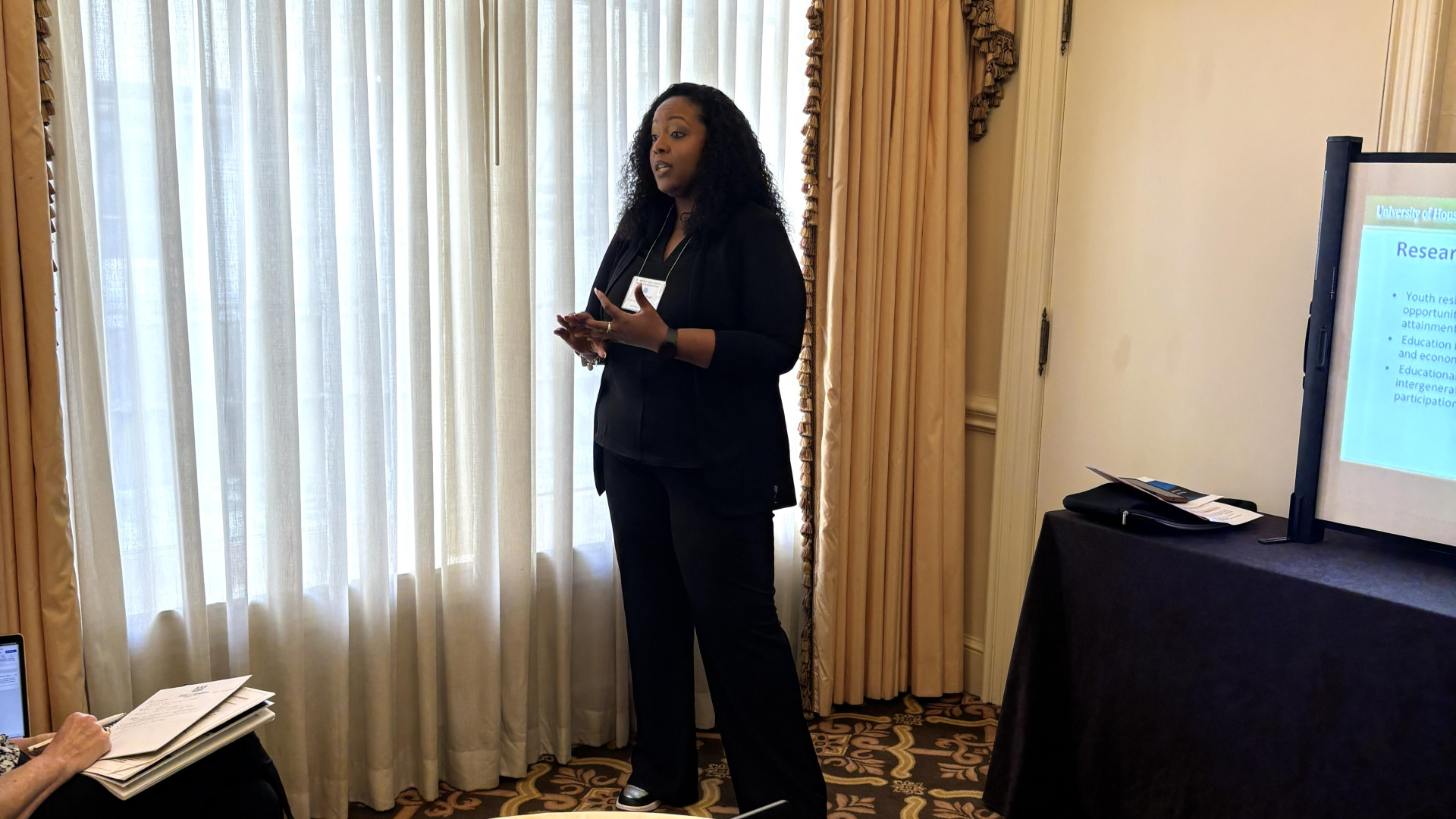
“When I became a principal, I recognized that the campus I would be serving was fighting many obstacles,” Bland explained. “The obstacles most often noted were the ones inside the campus and the district. However, I knew that the problem was bigger. I started asking, ‘Who forgot about the children?’”
That question now anchors her study of local government policies and youth-friendly city initiatives and how they shape educational opportunities for African American students living in poverty.
“If we want transformational change, we must look beyond campus walls,” Bland said.
Bland’s work challenges traditional educational research by situating equity within municipal leadership and policy decisions — zoning, transportation, recreation, and city planning — rather than focusing solely on schools.
“I hope local leaders begin asking a different set of questions,” she said. “How do our zoning, transportation, contract selections, and recreation policies influence educational opportunity? Are we including schools and local youth as strategic partners in city planning?”
Though she describes herself as “very early in the work,” Bland believes the gaps in the research are clear. With guidance from faculty mentors, including Dr. Michelle Peters, Dr. Antonio Corrales, and Dr. Jennifer Grace, she has refined her research questions and strengthened her scholarly voice.
“The EDLS program is pushing me to move from descriptive writing to analytical synthesis,” she said. “You revise. You refine. You persist.”
When she learned she had been selected for the Deans' Award, her reaction was simple: “I was surprised, honored, and humbled. My first thought was, ‘Me?’”
But the recognition reinforces her broader mission.
“The work is about ensuring that where a child lives does not determine the quality of opportunity they receive,” Bland said. “Demographics don’t have to determine destiny.”
Overcoming Barriers to Dual Credit Access
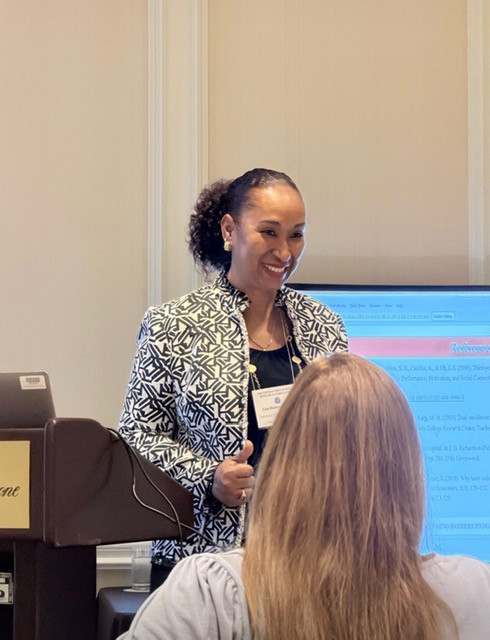
While Bland’s research focuses on city systems, Hudson’s scholarship centers on access within the educational pipeline itself, specifically dual credit programs.
Hudson chose UHCL because of its strong reputation for preparing practitioners in educational leadership.
“I recognized that to be successful as a leader in higher education, I needed a strong academic foundation in the field,” she said. “Higher education leadership is unique in many respects, requiring a deep understanding of governance, policy, finance, and institutional culture.”
Her interest in dual credit began not in a research seminar, but at home.
“My interest in dual credit came as a result of my own experience as a parent and not having the awareness about the program,” Hudson said. “Once I became aware of the program and its benefits, I was intrigued.”
Dual credit allows high school students to earn college credit while completing high school coursework. Research shows students who complete dual credit courses are more likely to matriculate, persist to graduation, and reduce overall college costs. Yet Hudson’s research highlights what she calls a “Dual-Credit Paradox.”
“There is the promise of ‘high impact’ but the reality of ‘unequal reach,’” she said.
Her study identifies three primary barriers: non-standardized implementation, geographic and institutional limitations affecting lower-income and minority-serving schools, and restrictive policy and eligibility requirements.
“Dual credit is often promoted as an access strategy,” Hudson said. “However, not all students have equal opportunities to enroll.”
She argues that social capital — access to information, guidance, and networks — plays a critical role in determining who benefits.
“The conversation has to shift from participation numbers to equitable design,” she said.
Hudson credits the rigor of the EDLS program and mentorship from professors such as Dr. Amanda Lanclos-Smith, Dr. Peters, and Dr. Grace with strengthening her methodology and analytical approach.
“Professors challenged me consistently to interrogate assumptions,” she said. “Through intensive feedback and scholarly dialogue, I developed stronger analytical rigor and a deeper understanding of equity-centered research methodologies.”
 Hudson also carries a personal legacy at UHCL. Her mother, Dr. Joan Pedro, is a former dean of the College of Education (COE). Still, Hudson says her passion for leadership solidified while teaching at YTEPP, a vocational institute she once attended as a student.
“I understood their uncertainties, ambitions, and desire for opportunity because I had once stood in their shoes,” she said. “That experience ignited my commitment not only to teaching but to leadership that creates access and transformative opportunities.”
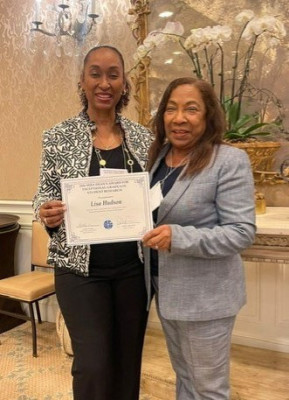
Receiving the Deans’ Award, she said, affirmed the quality and the urgency of her work.
“It highlights the importance of studying equity in access,” Hudson said. “Policies designed to increase opportunity must truly serve all students.”
Scholarship With Purpose
The SERA Deans’ Awards recognize graduate research that advances educational theory and contributes meaningfully to the field. For UHCL to have both of its nominees selected underscores the strength of its doctoral scholars and the EDLS program’s emphasis on research grounded in practice.
Bland and Hudson are studying different systems, but their work converges around a shared belief: opportunity must be intentional.
For Bland, that means asking cities to align policy with student outcomes.
For Hudson, it means designing access initiatives that reach the students they promise to serve. Both scholars see research not as an academic exercise, but as a tool for change.
“I want to get the research in front of people,” Bland said. “I don’t want it to just be a document.”
Hudson echoes that sentiment. “The scholarly evidence we produce has the power to address real-world problems that can ultimately change lives,” she said.
At UHCL, those lives and the systems that shape them are at the center of the work.
The future of education needs bold leaders. Explore UHCL’s EDLS program at www.uhcl.edu/education/departments/transformative-leadership-counseling-and-innovation/doctoral-educational-leadership/ to become one.