

The Opportunity to Succeed
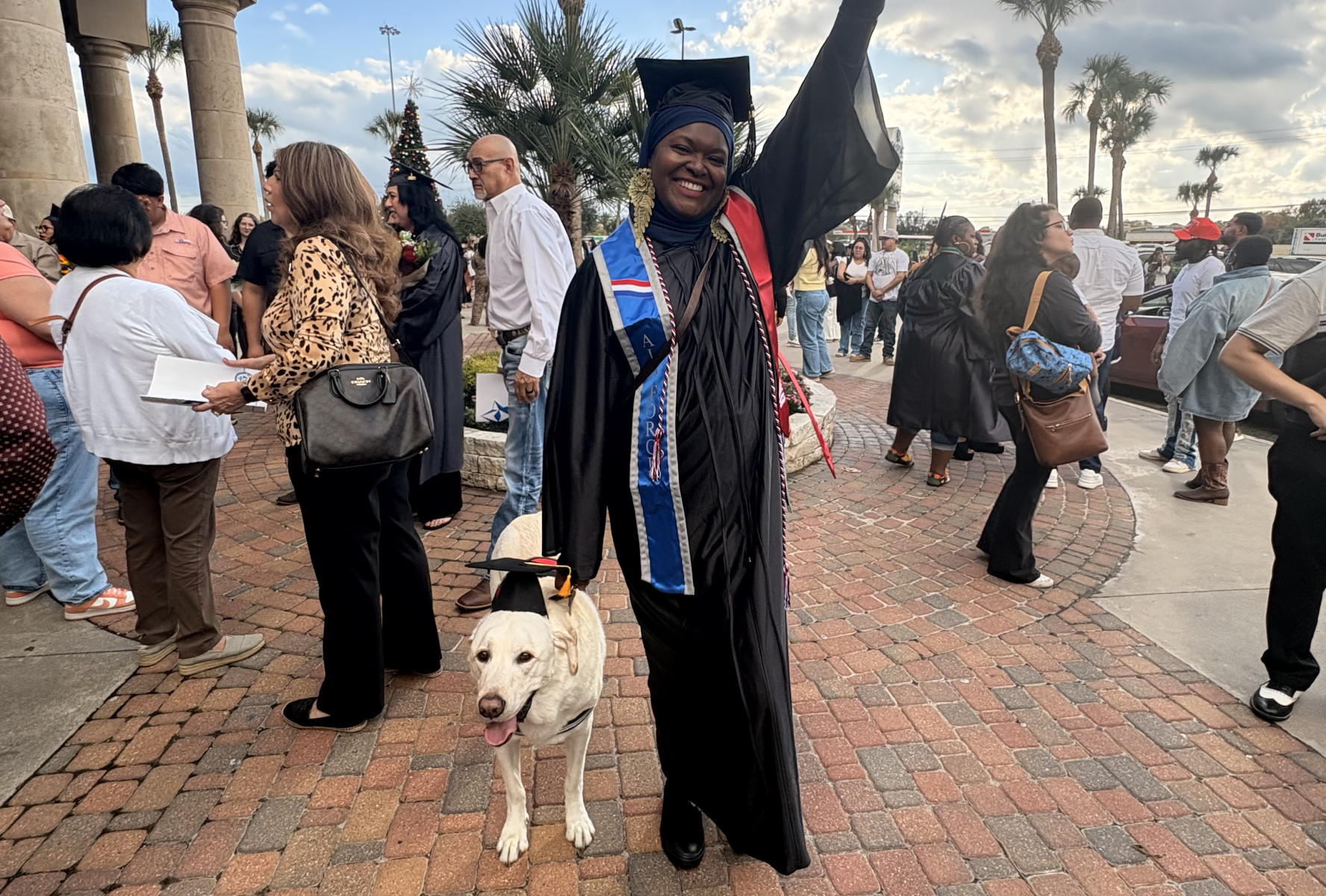
For veteran Tonie Marshall, a conversation with a UHCL professor changed how she viewed her abilities and what she could accomplish.
Tonie Marshall remembers sitting in a psychology classroom at University of Houston-Clear Lake, wondering whether she could continue.
The course relied heavily on discussion. Students exchanged ideas, conversations overlapped and background noise made it difficult for Marshall, who experiences hearing loss and other disabilities, to follow what was happening. At times, she became so overwhelmed that she stepped outside the classroom to collect herself.
"There's no way I can do this," she remembered thinking. "I can't hear. I can't think. How can I get through this?"
Marshall had worked hard to return to college. A retired combat veteran who served 20 years in the military, she sustained injuries during her service that required extensive medical care and rehabilitation. When her health stabilized, she began considering how she might use her experiences to help others.
"I wanted to help people the way people helped me," Marshall said.
That desire led her to study psychology at UHCL, with plans to pursue a career in mental health counseling. But returning to the classroom introduced challenges she hadn't fully anticipated.
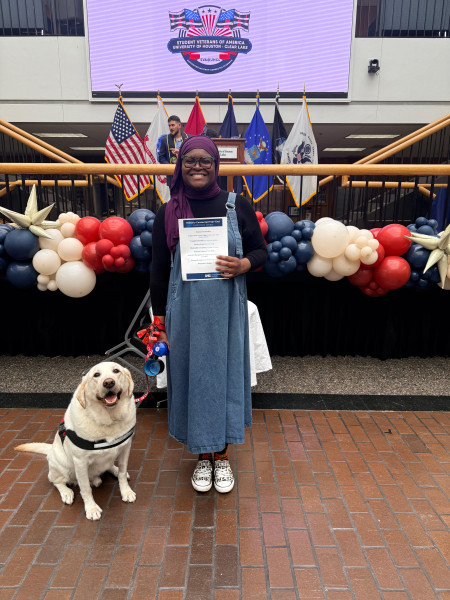 For Marshall, navigating higher education means managing disabilities that aren't always apparent to others. She works with the accessibility support center to obtain academic accommodations and communicates with professors about her needs. Still, the adjustments outlined in an accommodations letter don't always account for every situation a student may encounter.
In the discussion-intensive psychology course, Marshall initially tried to manage those difficulties on her own. After several weeks of struggling, she approached Giazú Enciso Domínguez, Ph.D., assistant professor of social psychology, to explain what she was experiencing.
The conversation became a turning point.
Enciso Domínguez hadn't realized how difficult the classroom environment had become for Marshall. Once she understood, she made adjustments that helped her student participate more effectively.
"She met me where I was, and I really, really appreciated that," Marshall said.
The experience changed how Marshall understood her own abilities. She had questioned whether she could handle the demands of advanced coursework. What she discovered was that her difficulty wasn't necessarily a reflection of what she could accomplish, but of whether she had the support needed to demonstrate it.
"She changed it for me because I really questioned whether or not I could do this," Marshall said. "It built my confidence to keep going."
That distinction has become central to Marshall's experience as a student.
"I don't want favors," she said. "I just want access."
For Marshall, advocating for herself has meant learning to communicate her needs without questioning her place in the classroom. She recognizes that her approach to learning may differ from that of other students, but she doesn't see those differences as limitations on what she can achieve.
With appropriate support, she has earned a 4.0 GPA.
Marshall has also found assistance through the Capt. Wendell M. Wilson Veteran & Military Resource Center, where staff began helping her before she enrolled in classes. They guided her through academic planning, financial questions and the process of accessing veterans' educational benefits.
Their support has extended to needs that might otherwise go unnoticed. When Marshall's class schedule required her to spend long stretches on campus, staff allowed her to store medication in the center's refrigerator.
"It's stuff like that when you know, hey, these people understand what we may possibly be facing," she said.
The center has also provided opportunities to connect with other veterans, reinforcing that she is part of a community of students whose experiences, responsibilities and needs may differ from those of their classmates.
For Marshall, those interactions reflect something she hopes more people will understand: individuals don't always arrive in a classroom with the same circumstances, and the challenges someone faces may not be immediately visible.
That perspective is shaping the kind of counselor she hopes to become.
Marshall is pursuing psychology at UHCL while completing addiction counseling coursework and practical training at San Jacinto College. She expects to complete her current training in December and hopes to begin graduate studies at UHCL in fall 2027, working toward becoming a licensed professional counselor.
Her interest in mental health grew from her own experiences receiving care and support. She wants to help reduce the stigma surrounding mental health conditions and work with people who may struggle to find or access the resources they need.
She is particularly interested in serving veterans, women, children and underserved communities. Through an emerging nonprofit effort called Gertrude's Table, she already prepares and distributes food and hygiene supplies to people experiencing homelessness in Houston. Her longer-term vision includes creating a space where individuals can access mental health services, therapeutic activities and practical assistance.
The work reflects her belief that people often need more than encouragement. They need someone willing to understand their circumstances and help them find a way forward.
Marshall knows what that difference can mean. She remembers the uncertainty she felt in the classroom and the professor who listened when she finally explained what she was experiencing. That conversation didn't change her academic goals or remove the work required to achieve them. It helped her recognize that she was capable of meeting those expectations.
Now, as she prepares for a career helping others navigate their own challenges, Marshall hopes to offer the same understanding that made a difference in her education.
"I am capable," she said. "It's just I have a unique way of getting there."