


Reaching for the moon: UHCL robotics team's journey in the 2025 NASA Lunabotics Challenge
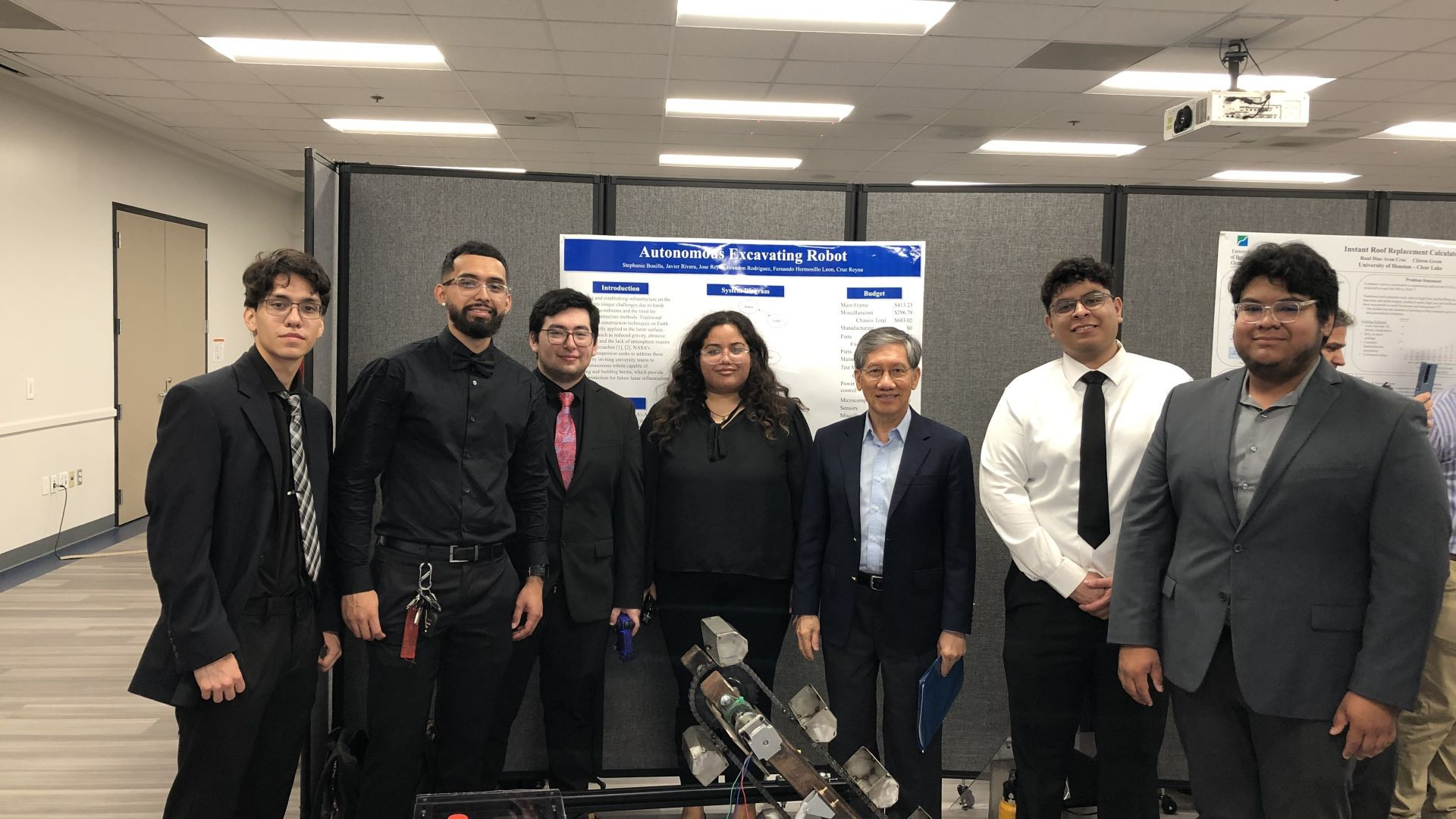
In the spring of 2025, a determined team of engineering students from the University of Houston-Clear Lake (UHCL) embarked on a bold and challenging mission: to design, build, and operate a fully autonomous lunar excavator as part of NASA’s annual Lunabotics Challenge.
Guided by faculty adviser Dr. Luong Nguyen, the team — composed of Fernando Hermosillo Leon, Cruz Reyna, Stephanie Bonilla, Brandon Rodriguez, Jose Reyes, and Javier Rivera — took on one of the most rigorous student robotics competitions in the nation.
Although it was UHCL’s first-ever entry into Lunabotics, the team demonstrated strong technical capabilities, innovative thinking, and an unwavering commitment to learning. Their efforts earned them a place in Event 2 of the competition, the Lunabotics Qualification Challenge held at the University of Central Florida (UCF), placing them among the top 35 teams selected from over 60 institutions nationwide.
About the NASA Lunabotics Challenge
Hosted annually by NASA’s Kennedy Space Center, the Lunabotics Challenge is designed to support the Artemis mission by engaging university teams in developing solutions for lunar excavation and construction. Now in its fifteenth year, the competition simulates the harsh and dusty lunar environment, tasking students with designing robotic systems capable of navigating and excavating simulated lunar regolith.
The challenge is divided into three main events:
Event 1: Systems Engineering Paper and Project Management Plan
Event 2: Lunabotics Qualification Challenge (LQC)
Event 3: On-Site Lunabotics Challenge at Kennedy Space Center
Each phase emphasizes technical performance and rigorous systems engineering practices, safety, risk mitigation, innovation, and collaboration — all vital to real-world NASA missions.
Laying the Foundation: Event 1 Success
The UHCL team began their journey with Event 1 — the submission of a detailed Systems Engineering Paper, Preliminary Design Review, Project Management Plan, and STEM Engagement activities. The team applied NASA’s systems engineering lifecycle model to their design process, breaking down complex problems into manageable subsystems and coordinating interdisciplinary efforts in software, electronics, mechanical design, and autonomy.
Their documentation demonstrated thoughtful consideration of mission requirements, clear traceability from needs to specifications, risk analyses, subsystem interface control, and a development timeline. The team also engaged with local schools and the broader Houston-area community to promote STEM education, a core requirement of the Lunabotics program.
Their thorough and professional submission earned them a spot in Event 2, advancing them to the Lunabotics Qualification Challenge in Orlando — a major milestone for a first-year team.
Building the Lunar Excavator
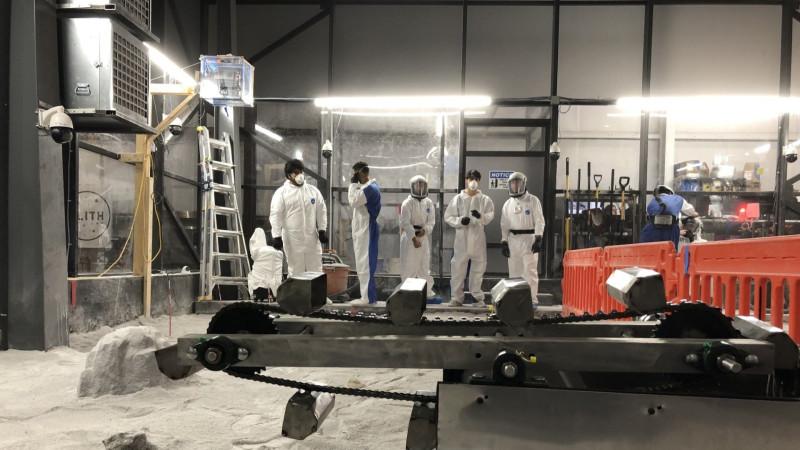
The team’s robot was designed to autonomously navigate a simulated lunar terrain, avoid obstacles, excavate regolith (BP-1 simulant), and deposit it into a designated collection zone. The design process included multiple trade studies where options were evaluated using weighted criteria such as mass, power consumption, autonomy level, dust tolerance, simplicity, and cost.
Key features of the robot included:
- A four-wheel differential drive system for reliable mobility and maneuverability.
- A front-mounted bucket chain excavator engineered to maximize regolith collection efficiency.
- Autonomous navigation enabled by an integrated sensor suite and computer vision algorithms, utilizing LIDAR and stereo cameras.
- A modular electrical architecture designed for seamless subsystem integration, real-time diagnostics, and built-in redundancy.
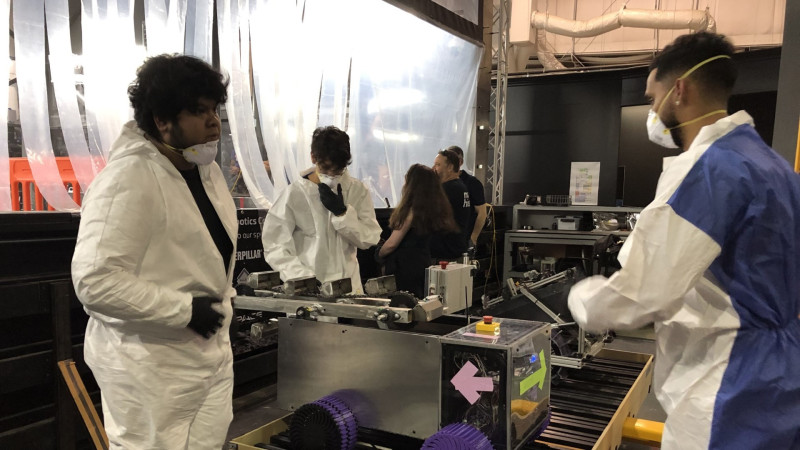
Mechanical components were 3D modeled using SolidWorks, and many parts were fabricated in-house or with support from UHCL’s fabrication lab. The software architecture leveraged ROS (Robot Operating System), allowing for flexible integration between navigation, perception, and excavation subsystems.
Competing at the Lunabotics Qualification Challenge
Held at the UCF in June 2025, the Lunabotics Qualification Challenge brought together top university teams to demonstrate the capabilities of their robots in a simulated lunar arena. While UHCL’s robot encountered some performance limitations during the LQC — such as dust-related interference in sensors and localization drift — the team successfully passed key readiness reviews and safety checks and was able to operate autonomously on the testbed.
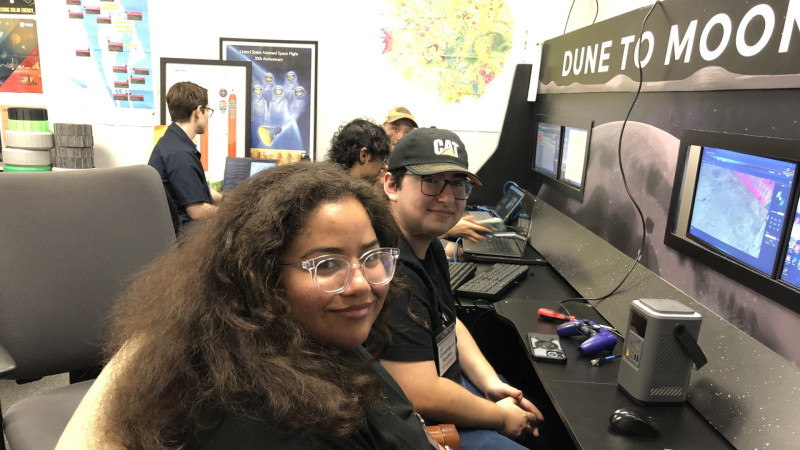
The experience was invaluable. Competing alongside seasoned teams with years of Lunabotics experience, UHCL’s students gained firsthand exposure to high-stakes engineering under pressure. They also had the opportunity to connect with NASA engineers, student peers, and university mentors from across the country.
Although the team did not advance to Event 3 at the Kennedy Space Center, reaching Event 2 in their inaugural year placed them in the top 60% of all participating universities, a remarkable achievement for a first-time competitor.
Lessons Learned and Looking Ahead
Participation in the 2025 Lunabotics Challenge proved to be an intense learning experience. Team members developed skills in:
Systems engineering and documentation
Project management and interdisciplinary coordination
Rapid prototyping and hardware/software integration
Autonomy and control in uncertain environments
Public speaking and outreach
Perhaps most importantly, the team gained insight into the iterative nature of engineering — embracing setbacks, debugging complex problems, and adapting to real-world constraints.
“We came into this competition as underdogs,” said team member Fernando Hermosillo Leon, “but we walked away with a deep understanding of what it takes to build something that could one day operate on the Moon.”
Looking forward, the team hopes to build on this year’s foundation. With lessons learned and an established workflow, future UHCL teams are poised to make even greater strides in subsequent Lunabotics competitions. Discussions are already underway to improve the mechanical design for weight reduction, enhance the autonomy stack with SLAM and UWB localization, and develop a more robust dust mitigation strategy.
A University Milestone
For UHCL, the success of its 2025 Lunabotics team is more than just a technical achievement; it's a milestone that signals the university’s growing presence in space-related research and education. It reflects UHCL’s commitment to giving students hands-on, mission-critical engineering experiences that mirror the challenges faced by NASA and industry leaders.
Faculty adviser Dr. Luong Nguyen praised the students’ perseverance and professionalism: “What this team accomplished in less than a year, starting from scratch, is truly impressive. They exemplified the spirit of engineering innovation, collaboration, and curiosity that we strive to cultivate at UHCL.”
Mission Ready
Though the Moon remains 238,855 miles away, the 2025 UHCL Lunabotics team took a giant leap toward it — not with rockets, but with gears, code, vision, and teamwork. Their story stands as a testament to what’s possible when students dare to dream big, work hard, and believe in each other. As the team continues to build momentum, one thing is certain: UHCL has officially entered the Lunabotics arena, and they’re here to stay.