






Beyond the Bedside
How UHCL’s MHA/MBA program is helping a Houston physician expand his perspective on healthcare leadership
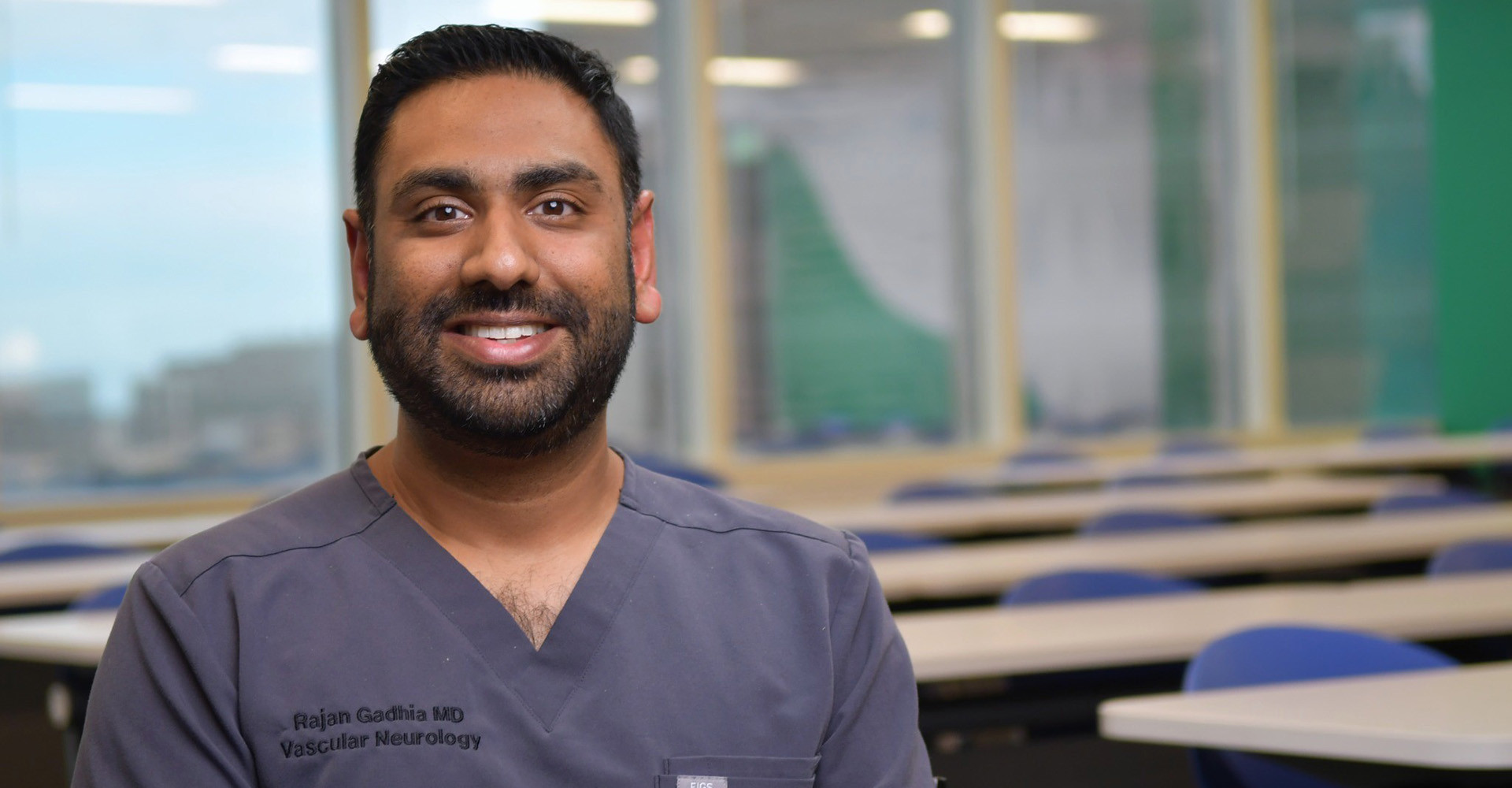
By the time Dr. Rajan Gadhia enrolled at the University of Houston-Clear Lake, he had already built a career many would consider firmly established.
A vascular neurologist at Houston Methodist, Gadhia had helped develop and expand a virtual neurology program that brings specialized stroke expertise to patients across the health system. He directs the program, trains future neurologists and holds leadership roles spanning stroke care, concussion treatment and medical education.
But the more Gadhia worked to improve how care was delivered, the more he began to see another side of healthcare.
“I feel like we have such a microscopic view of things,” he said of working within a particular profession. “You may be good at what you’re doing right now,” but seeing what else is possible requires exposure to different perspectives.
For Gadhia, that realization eventually brought him to UHCL’s joint Master of Healthcare Administration/Master of Business Administration program.
Expanding access to expertise
Gadhia’s interest in healthcare began early. His mother managed operations for specialty medical practices in Houston, and as a teenager, he spent summers helping in those offices. After shadowing a physician in a hospital, he knew he wanted to practice medicine.
He completed medical school and neurology training before pursuing a vascular neurology fellowship at Massachusetts General Hospital and Harvard Medical School. His time there included training in telestroke, then an emerging approach to delivering specialized neurological care remotely.
Gadhia returned to Houston Methodist with an idea.
His goal was straightforward: A patient experiencing a stroke should have access to the same level of specialized neurological care regardless of which Houston Methodist emergency room they enter or what time they arrive.
The virtual neurology program began at Houston Methodist The Woodlands Hospital and eventually expanded across all seven Houston Methodist hospitals and approximately 10 freestanding emergency rooms.
“We can bring the expert to the bedside 24 hours a day, seven days a week, 365 days a year,” Gadhia said.
The experience also exposed him to something medical training had not fully prepared him for.
Building and expanding a program required more than clinical expertise. It meant developing budgets, demonstrating value, working with hospital executives and making decisions about how limited resources could have the greatest impact.
As Gadhia began thinking about larger questions of healthcare access and how emerging technologies such as artificial intelligence could shape medicine, he wanted to better understand how those decisions are made.
“I thought I could bring a different side of this,” he said.
Learning the other side of healthcare
Gadhia knew he wanted to pursue an MBA, but conversations with mentors and other healthcare professionals led him to UHCL and its dual MHA/MBA program. 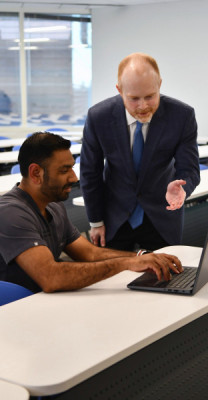 The distinction mattered to him. An MBA could provide a foundation in finance, organizational strategy and business. The MHA offered a deeper understanding of healthcare policy, payer systems, value-based care and the forces reshaping the industry.
For a physician interested in influencing healthcare beyond individual patient encounters, he wanted both.
“I don’t think that there’s ever a time where investing in more knowledge is ever going to be a bad thing,” Gadhia said.
The connection between the classroom and his professional life came quickly.
In a leadership course, Gadhia and his classmates role-played conversations among physicians, administrators and other stakeholders. At the same time, his own department was experiencing changes in leadership.
His classmates were not physicians, and their questions forced him to reconsider how he communicated needs that might seem obvious from a clinician’s perspective.
“Not everyone understands exactly what I’m saying,” he recalled realizing. “So I need to break it down and make it very clear.”
Finance courses provided another shift in perspective. Gadhia learned to read budgets and statements of operations and gained a greater understanding of the responsibilities facing administrators managing expenses, revenue and resources.
Rather than viewing a clinical need only through the lens of what would provide the best care, he could better understand the larger organizational question: Why should the institution make this investment, what resources will it require and how does it advance a longer-term strategy?
“I was able to step back and say, ‘I get it. Everyone is just playing their part,’” he said.
Investing in what comes next
Gadhia expects to complete the MHA/MBA program in December. Finishing it while maintaining a clinical practice, raising two young children and fulfilling his leadership responsibilities has required sacrifice.
He describes the experience as a “labor of love.”
“I didn’t need to go back to get an MBA/MHA to continue being a physician,” he said. “I needed it to be able to get to the next level and to be able to grow.”
For Gadhia, that next level is not necessarily a new title. It is the ability to enter conversations about the future of healthcare equipped to understand both the clinical and organizational sides of the decisions being made.
He can now look at a budget or statement of operations, understand what it means, question it and contribute to a broader discussion about an organization’s goals and strategy.
Three years ago, he said, he could not have done that.
Now, as Gadhia looks toward the next challenges facing healthcare, he sees his medical expertise and his UHCL education as complementary tools for addressing them.
“You will never go wrong investing in knowledge,” he said.